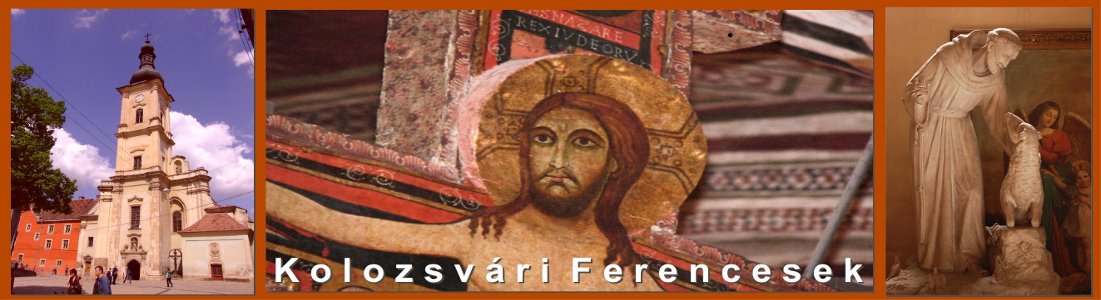
The Franciscan Church of Cluj-Napoca
Find the description of each site of interest using the numbers below!
Brief History of the Franciscan Church and Monastery of Cluj-Napoca
The present-day Franciscan church of Cluj-Napoca was most likely built on the site of a pagan shrine erected at the eastern edge of the Roman castrum. It is assumed that the originally semicircular-apsed basilica was replaced, after the 13th-century Tatar invasion, by a single-nave (Gothic) church, for whose construction John Hunyadi ordered an annual subsidy in 1455.
The northern side aisle of the church built by the Dominican friars was later converted into the monastery corridor, while the southern aisle was divided into three chapels. During the Reformation, after the Dominicans were expelled in 1556, the church and the adjoining monastery building were used by Protestant denominations.
During the Catholic Counter-Reformation, in 1725 the building came into the possession of the Franciscans, who remodeled it in the Baroque style:
Façade and tower: Between 1734–1745 the imposing 53-meter-tall onion-domed tower was built, articulated over three levels with a 4.5 x 4.5 m base. In 1747 the niched façade was completed, featuring statues of St. Francis and St. Anthony. Above the portal, a statue of the Virgin Mary was placed.
Windows and chapel: The Gothic windows were replaced by semicircular Baroque windows, and on the south side the Kornis family had the Loreto Chapel built (the artistic relief on the street façade, together with its chronogram, indicates the year 1743).
Surviving Gothic elements: The cross vault of the sacristy, as well as the net vault with 8 stone bosses of the adjacent hall (the Matthias Hall), resting on a single pillar.
The interior of the church today is a barrel-vaulted hall church, with three chapels on its southern side.
Further, more detailed information
The tower niche above the entrance is adorned with a Baroque statue of the order's Great Lady, the Immaculately Conceived Virgin Mary, made by the renowned János Nachtigall in the 1750s. In the two upper niches of the church façade stand the statues of St. Francis and St. Anthony. These, together with the façade relief of the Loreto Chapel depicting the transport of the House of Nazareth, were likewise made by the same master.
In 1902, the iron door still visible and in use today was made for the church's exterior street entrance, the work of local locksmith Ágoston Demjén.
The tower, articulated over three levels with a 4.5 x 4.5 m base, is imposing, with an onion dome, and stands 53 m tall. The masonry work, together with the façade cornices raised on the two sides of the tower, began in 1740 and was completed in 1743. The cross was placed on the tower in 1744; it fell and shattered in June 1779, and was replaced in 1780 with a new one made of iron, fitted with a copper sphere. In 1830 a comprehensive repair of the tower took place: the old tower roof was completely replaced, and the sheet metal needed for the covering was brought from Vienna. Later, during a further tower repair in 1898, a new iron cross 2.80 m tall was placed on top. Meanwhile, in 1772, at the initiative and expense of the town — chiefly the residents of the Old Citadel — a large clock was also installed in the tower, whose upkeep was meant to be the responsibility of the citizenry, though this was soon forgotten. Today, of the four bells in the tower, three are in use, but in practice only two are rung daily at Mass.
Reflection
We invite you to step into St. Francis's centuries-old heritage in Cluj.
1. Our Lady of Lourdes Altar
Brief overview
The Our Lady of Lourdes altar was commissioned in 1900, funded by a donation from Mrs. Korbuly (née Margit Bogdánffy), from the sculptor Ferdinand Stufleser, working in Gröden (South Tyrol).
Reflection
Pause for a moment: what does the veneration and presence of Mary mean to you?
More details…
The Lourdes grotto is a depiction made in memory of the Marian apparitions that took place at Lourdes, France, in 1858, replicas of which have been erected in numerous churches and shrines around the world. According to the account, the Virgin Mary appeared to Bernadette Soubirous in the rocky grotto of Massabielle, identifying herself as the Immaculate Conception and indicating the emergence of a spring at the foot of the grotto.
In our church, too, one can see a Lourdes grotto imitating an artificial rock formation, in which stands the statue of the Virgin — dressed in white, with a blue sash, barefoot, holding a rosary — before which kneels a smaller statue of Bernadette, gazing up at her in prayer. It was commissioned in 1900, funded by a donation from Mrs. Korbuly (née Margit Bogdánffy), from the sculptor Ferdinand Stufleser, working in Gröden (South Tyrol).
2. The Altar of St. Thérèse of Lisieux (the "Little Flower")
Brief overview
In honor of the French Carmelite nun St. Thérèse of Lisieux (1873–1897), canonized in 1925, the altar painting was created in 1926 by Sándor Szopos. Its distinctive feature is that the female members of the editorial staff of the St. Bonaventure printing house served as models for the angels surrounding Thérèse.
Reflection
Great love shows itself not in great deeds, but in small, faithful gestures.
What small gesture could you use to show love today / in the coming days?
More details…
In honor of St. Thérèse of the Child Jesus of Lisieux (1873–1897), canonized in 1925, the Franciscans commissioned an altar painting from Sándor Szopos in 1926, placed on the church wall facing the monastery, right in front of the choir area. The essence of her spirituality is the so-called "little way" (a simple, humble form of spirituality): the desire to approach God not through great deeds, but through childlike trust and love lived out in the small acts of everyday life. Her autobiographical writing published after her death, "The Story of a Soul," achieved immense popularity, and her simple, deep faith touched many people.
The distinctive feature of the altar painting is that the female members of the editorial staff of the local Franciscan St. Bonaventure printing house and publisher (1906–1948) served as models for Thérèse and the 3 angels around her.
3. The Altar of St. Anthony of Padua
Brief overview
In 1899, from public donations, the statue of St. Anthony with the Child Jesus was erected, after which the Tuesday devotions and bread distribution were introduced; the current high altar was completed in 1906. Devotion to St. Anthony survived even during the communist era, and today the practice of venerating this intercessor saint is kept alive through two Tuesday Masses, thanksgiving plaques, and bread donations.
Reflection:
St. Anthony is the finder of lost things — what/whom are you searching for this evening?
More details…
St. Anthony of Padua (1195–1231), a Franciscan friar, is perhaps one of the best-known saints, regarded as the finder of lost things and the solver of difficult situations. His depiction is consistent worldwide: a Franciscan habit, a white lily in one hand, and the Child Jesus in his other arm.
In our church, the life-size statue of St. Anthony, with the Child Jesus on his arm, was erected in 1899 from public donations, with its collection box intended for the care of the poor. Already the following year, the Tuesday devotions are recorded — that is, the holding of Masses and the distribution of collected bread. The current high altar was completed in 1906, as a donation and personal work of the master carpenter Lajos Bak.
The strong tradition of devotion to St. Anthony survived even during the communist era, though with less bread and fewer donations, through the celebration of Tuesday Masses. Fervent devotion to St. Anthony is present today as well: two Masses are celebrated every Tuesday, and the many thanksgiving plaques, donations, and the hundreds of loaves of bread collected each Tuesday attest, in their way, to the centuries-old intercessory power of the saint of Padua, regardless of denomination or linguistic background.
4. The Pulpit
Brief overview
The richly carved, gilded Baroque pulpit was made in 1740. On its parapet are a relief of Christ and reliefs of the four Evangelists, and on top stands the statue of the Savior holding the cross.
Reflection:
When did you last read Scripture? / When did you last listen to a sermon?
More details…
The pulpit stands beside the pointed-arch-framed door connecting the monastery corridor to the church. It is a richly carved Baroque work of vigorous execution, presumably by János Nachtigall, made in 1740 from the donation of Miklós Torma and his wife Judit Száva. In the center of the parapet is a relief bust of the Lord Jesus with a globe, flanked on either side by busts of the four Evangelists. On top of the pulpit stands the Savior holding the cross, depicted in a form expressing his glorified and judicial nature.
5. The Sacred Heart of Jesus Altar
Brief overview
The painting of the Sacred Heart altar was made in 1734; the original painting was replaced in 1900, from a donation by János Mandy, with a life-size statue of the Sacred Heart of Jesus, with the Holy Guardian Angel above and St. Joseph with the Child Jesus below.
Reflection
What gratitude/burden would you bring today to this Heart?
More details…
The Sacred Heart altar, together with its painting, was erected by Zsigmond Csáki and his wife, Katalin Haller, according to the visible inscription, in 1734. Later, in 1900, a life-size cast and painted statue of the Sacred Heart of Jesus was placed in the painting's stead, through the generosity of the railway conductor János Mandy. In the round frame at the top of the altar is the Holy Guardian Angel, and in the lower part, under glass, St. Joseph with the Child Jesus.
6. The High Altar – the Rotating Altar
Brief overview
The 1730 painting of Our Lady of the Snows (a copy of the ancient Marian icon of Santa Maria Maggiore in Rome) is part of a rotating altar: on the rotating axis behind the fixed frame, three images/statues alternate according to the feast being celebrated.
Reflection
It is not the image itself that matters, but the One it points to.
Whichever way you turn, God's love always turns toward you.
More details…
The current high altar, along with the church itself, was consecrated in honor of Our Lady of the Snows, which took its name from Rome's first Marian shrine, Santa Maria Maggiore. The miraculous icon there was, according to tradition, painted by the Evangelist St. Luke. The "painted icon" of Our Lady of the Snows for the high altar of the Cluj Franciscan church was commissioned in 1730 by Mária Ettinger, a resident of Sibiu, from a master craftsman in Brașov. At the bottom of the painting is the inscription: "Vera effigies S. Mariae Maioris ad Nives," meaning "The true image of Our Lady of the Snows." The high altar is also special in that it is not static but rotatable. In the central part, behind the fixed frame, on a rotating axis fitted with three equally formed recessed niches around the full circle, are placed the painting of Our Lady of the Snows, a statue of the Heart of Mary, and a crucified Christ. For most of the year the painting is displayed in front, the statue in the months of May and October, and the cross during the period of suffering — that is, during Lent and Advent. Behind the high altar a platform was built, from which the rotating altar is adjusted. Its special feature is that its flooring was made from pieces of a 17th-century coffered ceiling (from a church or prayer hall once used by Protestants). On the two sides of the upper part of the high altar, a winged angel on each side flanks the Sacred Heart of Jesus, radiating a wreath of rays amid soft clouds and putti, encircled by a crown of thorns. At the very top of the high altar, beneath the cross reaching up to the sanctuary vault, is the small Franciscan coat of arms, also visible in several other places in the church, such as the top of the organ, the nave's vaulted arch, and the side altars. On the right and left of the altar stand King St. Stephen and King St. Ladislaus with their characteristic attributes. On the south side of the sanctuary is the ornate parapet of the vespers throne, divided into two rows of three panels each.
7. The Ceiling Frescoes
Brief overview
The church ceiling was painted in 1900 with scenes of Franciscan subject matter, the work of the Cluj painter János Adorján.
Reflection
St. Francis's heart was always turned upward, toward God — lift your gaze as well.
More details…
In 1873 the church was whitewashed again. On the occasion of the interior mural painting in 1900, the church ceiling was decorated with frescoes of Franciscan subject matter, depicting the most important events in the life of St. Francis, created by the Cluj painter János Adorján. Their blessing took place on September 21 of that year, with the participation of Bishop Gusztáv Mailáth.
8. The Organ
Brief overview
The instrument was built in 1908 by the Angster József és Fia company of Pécs, and was later expanded. It had 2 manuals and pedal, with 26 registers. In 1926, the Wegenstein L. Fiai company of Timișoara built a new console and expanded the organ to 32 registers, making it a 3-manual instrument with pedal.
Reflection:
The sound of the organ builds a bridge between heaven and earth!
The voice of the organ lifts the heart in praise of God!
More details…
In 1781 the Franciscan community purchased a new organ for the church, made possible by a donation from the countess Miss Sára Teleki. No information survives about the earlier organ. The organ, worn by use and time, was rebuilt in 1875 at the initiative of the guardian Fr. Gábor Váncsa, together with the organ builder István Kolonics. The instrument still in service today was built in 1908 by the Angster József és Fia company of Pécs (opus 625). It had 2 manuals and pedal, with 26 registers. In 1926 the Wegenstein L. Fiai company of Timișoara built a new console and expanded the organ to 32 registers, making it a 3-manual instrument with pedal: Great Organ, Swell, and Echo/Remote division. Its range was also extended to 56 notes (C – g3), with a total of 1,978 pipes. The smallest pipe is about 1½ cm without its foot, and the largest about 5.1 m including its foot. The third manual, functioning as an echo division, was built into a small room at the end of the upstairs corridor of the monastery built against the church wall, whose window opened directly onto the church sanctuary. The first two manuals and the pedal remained pneumatically operated, while the third manual received electropneumatic control. The 6 new rows of pipes were added as an expansion of the second manual. The old Angster console was given to the Franciscans of Târgu Mureș. In 1949 the state authorities opened a music school in the nationalized monastery building, so the third manual remained on foreign territory until 1971, when the school's administration, at the request of the then church director, permitted its removal and installation on the church choir. Thus the third manual's role as a remote division ceased, and it became fully integrated into the organ, although its electropneumatic mechanism requires a complete overhaul.
9. The Altar of St. Francis
Brief overview
The altar was made in 1736 at the expense of Count István Mikes and his wife, Rozália Petki, on the initiative of parish priest Mihály Szabó, with the Archangel St. Michael above, St. Anne below, and a statue of St. Francis in the center.
Reflection
St. Francis of Assisi did not wish to possess, but to love — everything and everyone. Where do you stand on this?
More details…
One of the northern side altars was made in 1736, at the initiative of the devoted Cluj parish priest Mihály Szabó, at the expense of Count István Mikes and his wife, Countess Rozália Petki. The round painting above the altar depicts the Archangel St. Michael; below, under glass, is St. Anne, and in the center stands the life-size cast and painted statue of St. Francis. The statue depicts St. Francis in the traditional Franciscan habit (a brown robe), with a cord tied in three knots at his waist, alluding to the vows of poverty, chastity, and obedience. In one hand he holds a cross, drawing attention to repentance and the following of Christ, while on his other hand the stigmata — Christ's wounds — are visible, indicating that the marks of Jesus's suffering also appeared on Francis's body.
10. The Holy Cross Chapel – the Kornis Cross
Brief overview
Zsigmond Kornis, governor of Transylvania, donated this 16th-century Renaissance crucifix to the church in 1731, from his castle at Sânbenedic (in the Cluj area). The 175 cm tall cross, from an unknown master, was made of elm wood — the hardest wood to work — assembled from several pieces, with only the crown of thorns carved from a single piece of wood.
Reflection
What or who is your cross? Or perhaps — whose cross might you be?
More details…
The first chapel, counting from the church's sanctuary, is the Holy Cross Chapel, remodeled in 1730 by Zsigmond Kornis, governor of Transylvania. Into the new chapel he brought the great miracle-working crucifix from his manor at Sânbenedic, which was placed above the altar on February 23, 1731. According to records, not only people from Cluj came here, but pilgrims also came to the foot of the Holy Cross from the surrounding region: from Dej, Gherla, Turda, and even from Timișoara and Gheorgheni. Many who received answers to their prayers gave commemorative objects to the chapel out of gratitude, as a token of thanks for the grace received: "By 1738, 159 silver votive objects and 20 painted images already hung around the altar of the Holy Cross." The cross's distinctive feature is that it is 175 cm tall, its maker is unknown, and its material is elm wood, the hardest wood to work. It is assembled from several pieces: the two arms are separate, the face and half the skull consist of two pieces, the torso is joined from three lengthwise pieces, the shin from the knee down and the foot are likewise separate pieces, but the crown of thorns itself is carved from a single piece of wood. The carving is exquisite — even the vertebrae on the back are worked in detail. The artist was thoroughly familiar with human anatomy, and this knowledge is evident especially in the rendering of veins and muscles. The entire body is painted with a chalk-based paste and tempera. The cross on which the body hangs, together with the nails, is of later origin.
11. St. Stephen's Chapel – the copy of the Miraculous Statue of Șumuleu Ciuc
Brief overview
In the painting of the side altar dedicated to King St. Stephen, the founding king of the state offers his people and his crown to Our Lady, with his son, Prince St. Emeric, depicted above.
Opposite it, in 1946, from the donations of the faithful, a carved copy of the Miraculous Statue of Our Lady Help of Christians of Șumuleu Ciuc was placed, in memory of the fact that the original statue found refuge here from the front line during the two World Wars (1916, 1944).
Reflection
Once, this statue fled / hid from bombs / from war — what are you running from now, what keeps you from resting?
Mary still offers refuge today — the only question is, what "war" are you in right now?
More details…
This side altar was consecrated in honor of King St. Stephen and was erected here, for burial purposes, by the royal councilor István Kornis, war commissioner of Transylvania. The painted altarpiece depicts the founding king of the state at the moment he offers his people and his crown to Our Lady. In the trefoil frame crowning the altar's pedestal is a smaller painting with a bust of Prince St. Emeric, painted by the renowned heraldist József Keöpeczi Sebestyén in 1947.
In this chapel, on December 8, 1946, through the generosity of the faithful, a smaller copy carved from linden wood of the Miraculous Statue of Our Lady Help of Christians of Șumuleu Ciuc found its place, in memory of the fact that during the First World War (autumn 1916 – spring 1920) and the Second World War (September 1944 – April 1945), the original statue from Șumuleu Ciuc found refuge here from the advancing Soviet–Romanian–German front. The copy of the statue was carved by the Cluj sculptor Károly Bertalan in 1946.
12. The Statue of St. Joseph and the Child Jesus
Brief overview
The cast statue of St. Joseph, from 1901, is shown with the Child Jesus in his lap. In the frame above the altar is a painting of St. John the Baptist.
Reflection
The "silent giant": Joseph protected, without words, what he loved — his family. And you?
It is not loud words but faithful presence that protects a family — as Joseph did!
More details…
This side chapel was originally consecrated in honor of St. John Nepomuk. Currently, on the altar can be seen a larger cast statue, dating from 1901, of St. Joseph with the Child Jesus in his arms. In the frame above the altar is a painting of St. John the Baptist. All of this was erected by the treasurer János Toroczkai in 1737, who reserved the right of burial beneath the altar.
13. The Loreto Chapel → an entrance into silence
Brief overview
The exterior façade relief of the chapel (also a work by Nachtigall) depicts the transport of the House of the Holy Family.
Reflection
As you enter, please keep silence — this space already belongs to prayer. Give thanks, ask, or simply be present in silence!
More details…
The Loreto Chapel is a Baroque-era copy of the Virgin Mary's house in Nazareth, the so-called Holy House, which, according to tradition, angels carried from the Holy Land to Italy, to the present-day town of Loreto, where it has since been venerated as a famous place of pilgrimage. Following the model of the Italian basilica at Loreto, similar chapels were built in numerous churches across Europe, including Transylvania — especially at Franciscan sites — with a copy of the miraculous statue of Loreto on their altar, which was often touched to the original statue before being consecrated. In many places, as here in Cluj, the color of the Virgin is black. Tradition traces the explanation of this to verse 1:5 of the Song of Songs ("I am black, but beautiful" — "Nigra sum sed formosa"): medieval Marian devotion applied this biblical verse to the Virgin Mary, so that the dark hue is not a deficiency but rather a sign of beauty and mystical depth.